Tuesday, July 19, 2016
Blog Hacked
It appears our blog has been hacked, so for the time being we are going to suspend this account until we can investigate further.


Friday, July 8, 2016
Paving Ahead!
Summer kicks off paving projects in Cowlitz
and Wahkiakum counties
Work to resurface more than 32 miles of
highway on SR 4, SR 411 and SR 432 begins July 11
Beginning Monday, July 11, crews
will resurface nearly13 miles of existing pavement on State Route 4,
between Kandoll Road and east of Ingalls Road through Cowlitz and
Wahkiakum counties. The highway will receive a new coat of oil and gravel chips
with this $1.6 million project.
Beginning Monday, July 11, crews
will resurface more than 12 miles of pavement on State Route 411 between
Longview and Castle Rock. This $2.4 million project includes intersection,
crosswalk and striping enhancements along the corridor.
Beginning Monday, July 11, crews
will resurface more than 7 miles of pavement on State Route 432, from SR 4
to 3rd Avenue in Kelso. As part of this $2.5 million dollar project crews
will also replace more than 60 broken and unstable concrete panels under the
pavement surface.
What can drivers expect during
construction?
During all three projects, drivers
should add extra time to their trips and prepare for delays due to lane and
travel restrictions. WSDOT offers a variety of tools to help drivers:
- Lane-closure
information is available on the Construction Update & Travel
Advisory.
- Sign
up to receive email updates about these projects and other WSDOT
news.
- Get real-time traffic information with the WSDOT mobile
app and by following WSDOT’s regional Twitter
feed.Work on these projects is weather dependent and scheduled for
completion in fall 2016.
The End Result This work will preserve highway infrastructure and extend the useful life of the highways. It also creates safer driving conditions for the thousands of travelers who use these stretches of roadway each day.
Hyperlinks within the release:
-
SR 4 project information: www.wsdot.wa.gov/projects/sr4/kandollrdvictowvalleycrkbridge/
- SR 411 project information: www.wsdot.wa.gov/Projects/SR411/firstavetoi5pavement/
- SR 432 project information: www.wsdot.wa.gov/projects/sr432/sr4toindustrialwaypaving/
- Southwest Region Construction Update and Travel Advisory:
www.wsdot.wa.gov/regions/southwest/construction/
- Sign up to receive project updates: https://service.govdelivery.com/accounts/wadot/subscriber/new
- WSDOT mobile app: www.wsdot.wa.gov/Inform/mobile.htm
- Southwest Region Twitter feed: www.twitter.com/wsdot_sw
###
WSDOT keeps people, businesses and the economy moving by operating and improving the state's transportation systems. To learn more about what we're doing, go to www.wsdot.wa.gov/news for pictures, videos, news and blogs. Real time traffic information is available at www.wsdot.wa.gov/traffic or by dialing 511.
Wednesday, July 6, 2016
Is Your Pet Prepared?
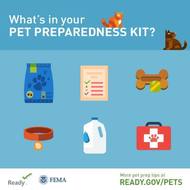 Every member of
your household should be prepared for disasters. That means pets, too! Every member of
your household should be prepared for disasters. That means pets, too!
Just
as you would create a disaster supply kit for yourself, be sure to also
assemble one for your pet. In addition to having enough food and water to
last at least three days, the Ready Campaign
recommends:
·
Medicines
and medical records: Keep an extra supply of
medicines your pet takes on a regular basis in a waterproof container as well
as records with any instructions;
·
Collar with
ID tag, harness or leash: Your pet
should wear a collar with its rabies tag and identification at all
times. Include a backup leash, collar, and ID tag in your
pet’s emergency supply kit;
·
Crate or
other pet carrier: If you need to evacuate in an
emergency, take your pets and animals with you; and
·
Sanitation: Include pet litter and litter box if appropriate,
newspapers, paper towels, plastic trash bags, and household chlorine bleach
to provide for your pet’s sanitation needs. You can use bleach as a
disinfectant (dilute nine parts water to one part bleach), or in an emergency
you can also use it to purify water.
Note: Please store chlorine bleach safely! Keep products containing
hazardous materials such as chlorine bleach in their original containers and
never remove the labels; never store hazardous products in food containers;
and never mix chlorine bleach with any other household cleaning products.
Mixing may cause chemicals to react, ignite, explode, or release poisonous
gases that will cause very serious breathing problems or death.
For the full list of items you
should include in your pet’s kit, download
Preparing Makes Sense for Pet Owners today!
Keep your pet prepared while on
the go using the American Red Cross Pet First Aid mobile app. Use this app to
help your furry friends during emergencies until you can get to a
veterinarian. It’s available for download on Apple and Android devices.
|
Friday, July 1, 2016
Fireworks Safety
Fireworks
Safety
 Stay safe this holiday. Fire and safety experts agree
the best way to enjoy fireworks is from a distance. Leave the fireworks to the
professionals! Stay safe this holiday. Fire and safety experts agree
the best way to enjoy fireworks is from a distance. Leave the fireworks to the
professionals!
Fireworks are often used to mark
holidays and special events. While these displays may be visually appealing,
they present dangers for consumer use. According to the Consumer Product
Safety Commission (CPSC), hundreds of people are injured each Fourth of July
while using consumer fireworks, including sparklers and firecrackers.
Get the facts about fireworks
safety to share with family and friends. Take a look at this fireworks safety video and visit the CPSC Fireworks Information Center.
|
Tuesday, June 21, 2016
Don't Take to the Trails Without These 10 Essentials
The key to keeping a hike safe and enjoyable is making sure you have the right gear.
- Trail shoes or boots
- GPS, map and compass. A GPS enabled device is handy, but go old-school too. Always carry a map and compass as a backup should your electronic device die or should the unit be unable to pick up a signal
- Extra water and way to purify water should you run out and need to use lake or stream water.
- Rain gear and extra clothing. Try to avoid cotton, which keeps moisture close to your skin.
- Safety items--such as flashlight, whistle and a way to start a fire.
- Extra food
- First aid kit
- Knife or multi-purpose tool
- Sunscreen and sunglasses
- Daypack/Backpack
Tuesday, June 7, 2016
Know Your Role in Wildland Fire Preparedness
You can take steps to improve your safety and potentially reduce damage to your property by taking personal responsibility and action!
READY: Dispose of or relocate combustible material from around your home. Trim trees and bushes to allow ample space between your home and landscape vegetation.
SET: Arrange your "go kit" with prescription medication, emergency supplies, important documents and other essential items. Create your own wildland fire action plan, involve your family and practice exit plans from your home and from your neighborhood.
GO: Get your "go kit" and leave well before the threat approaches. Stay aware of the situation and cooperate with local authorities during evacuation and re-entry processes.
From www.wildlandfirersg.org
READY: Dispose of or relocate combustible material from around your home. Trim trees and bushes to allow ample space between your home and landscape vegetation.
SET: Arrange your "go kit" with prescription medication, emergency supplies, important documents and other essential items. Create your own wildland fire action plan, involve your family and practice exit plans from your home and from your neighborhood.
GO: Get your "go kit" and leave well before the threat approaches. Stay aware of the situation and cooperate with local authorities during evacuation and re-entry processes.
From www.wildlandfirersg.org
Wednesday, June 1, 2016
Register for free boating class
The last free Adventures in Boating certification course until fall, sponsored by the Cowlitz County Sheriff’s Office Marine Division, takes place from 8 a.m. to 3:30 p.m. Saturday, June 4, at the Cowlitz County Search and Rescue Building, 1800 Western Lane, Kelso. Early registration is suggested because classes fill up quickly.
Participants who take the one-day class will be certified to operate a vessel in Washington. Classes are open to anyone who needs to obtain a Washington State Boaters Education Card.
All vessel operators 59 years old and younger must have a Washington Boaters Education Card to operate a vessel in the state. For additional information and resources, visit www.boatered.org.
To register for the class, call Deputy Jordan Spencer at 360-577-3092 or send an email to spencerj@co.cowlitz.wa.us.
Subscribe to:
Posts (Atom)